The Reserve Bank of India (RBI) is set to revise its directives for bank boards, aiming to alleviate operational burdens and enable them to concentrate on crucial policy and strategic decision-making, thereby enhancing corporate governance in the Indian banking sector.
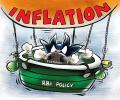
The Indian government has extended the Reserve Bank of India's (RBI) mandate to maintain retail inflation at 4 per cent, with a tolerance band of 2 per cent on either side, for another five years until March 2031.

India's retail inflation marginally increased to 3.4 per cent in March, up from 3.21 per cent in February, primarily due to an uptick in certain food items and the initial impact of the West Asia crisis on fuel prices, according to government data.

The Reserve Bank of India (RBI) has opted to keep its key interest rates unchanged at 5.25%, anticipating a global economic recovery following a ceasefire in the US/Israel-Iran conflict, despite ongoing inflationary pressures and currency fluctuations.

In the wake of the Chinese war, it was felt in some circles that it would be feasible to make a frontal attack on demand for gold in India. Accordingly, the Gold Control Order 1962 was issued, banning the making and selling of jewellery above 14 carats, making it compulsory for gold smiths to be licensed and submit accounts of all gold received and utilized by them etc., The measures met with lot of resistance and criticism.

The Reserve Bank of India (RBI) is developing digital public infrastructure and payments intelligence platforms using artificial intelligence and application programming interfaces to improve customer experience and strengthen the payments ecosystem.

India's forex reserves jumped by another $14.36 billion to a new all-time high of $723.77 billion during the week ended January 30, the Reserve Bank said on Friday.

The Indian rupee rebounded against the US dollar following intervention by the Reserve Bank of India, amidst ongoing concerns about foreign capital outflows, rising crude oil prices, and geopolitical instability.

Unified Payments Interface (UPI) has reached a record Rs 314 lakh crore in transaction value in FY26, representing more than a 4,000-fold increase since inception.

India's forex reserves dropped by $1.01 billion to $697.93 billion for the week ended June 20, the Reserve Bank of India said on Friday. In the previous reporting week, the reserves had jumped by $2.29 billion to $698.95 billion.

India's privatisation push, once projected as a cornerstone of economic reform, has suffered another setback, with the Centre set to call off the IDBI Bank stake sale, highlighting the political and structural constraints shaping the country's disinvestment policy, experts say.

India's forex reserves jumped by $1 billion to $687 billion during the week ended December 5, the RBI said on Friday. In the previous reporting week, India's forex reserves had dropped by $1.88 billion to $686 billion.

The Reserve Bank on Tuesday proposed greater flexibility to authorised persons to undertake foreign exchange transactions for hedging their exposures, balance sheet management and market-making, as well as to ease reporting obligations, after a review of the current regulations.

'What exactly is on the prime minister's mind, we do not know. But it feels like the government wants the country to be prepared for unseen challenges ahead.'
The Reserve Bank of India's dilemma over rates is its alone.

The Reserve Bank of India (RBI) Governor Sanjay Malhotra is now confronting the classic growth-inflation tradeoff, a situation exacerbated by the West Asia war, which threatens to end the 'goldilocks period' of low inflation and robust growth.

The rupee declined 31 paise to settle at 90.65 against the US dollar on Friday, weighed down by geopolitical uncertainties over the US-Iran talks, and a sharp rise in global crude oil prices.

The measures announced by it risk backfiring, disrupting the foreign exchange market, and intensifying the very pressures they seek to contain, with broader consequences for the economy points out Rajeswari Sengupta.

RBI Governor Sanjay Malhotra stated that the central bank is closely monitoring whether the supply shock from the West Asia conflict will lead to a generalised price rise, potentially necessitating monetary policy action.

Indian stock markets experienced a significant rally following the announcement of a US-Iran ceasefire, coupled with a drop in crude oil prices. The Sensex and Nifty both closed nearly 4 per cent higher, mirroring gains in global markets.

The Reserve Bank of India (RBI) has introduced its 'Payments Vision 2028' document, outlining initiatives to enhance digital payment security, introduce electronic cheques, and expand regulatory oversight to include e-commerce entities.

Even if there is an early agreement on a cessation of hostilities in West Asia, the price shock will not go away easily, points out A K Bhattacharya.

Indian stock markets recovered from early losses to close higher, driven by value buying in IT and banking shares and a rebound in the rupee.
The Reserve Bank of India (RBI) announced that it processed 99.8% of applications within the prescribed timeline under its Citizen's Charter in February, demonstrating high efficiency in its operations.

India's market regulator, Sebi, has approved the re-introduction of open-market share buybacks through stock exchanges, effective August 1, 2026, alongside easing debt listing norms for RBI-regulated entities and simplifying rules for mutual funds and alternative investment funds.

The RBI has removed Yes Bank from its caution list of monitoring foreign investment following the dip in shareholding by foreign investors below the prescribed limit.

Global oil prices fell on Thursday to their lowest levels since before the outbreak of the Iran conflict, offering a significant economic tailwind for India, the world's third-largest crude importer, by easing inflation risks, reducing the import bill and improving the government's fiscal position.

Private sector lender IDFC First Bank has lowered its savings account rates and introduced new slabs for small and medium balance categories, effective January 9, 2025, as per its website. The interest slabs and rates for higher balance accounts remain unchanged. Despite the revision, the bank continues to offer one of the highest savings account interest rates in the industry among mid-sized banks.

The Indian rupee rebounded 50 paise from its all-time closing low to settle at 96.36 against the US dollar, driven by retreating crude oil prices, signs of easing geopolitical friction, and likely central bank intervention.

It is unlikely that the RBI will drop rates until the inflation rate drops below five per cent.
The Indian government is integrating artificial intelligence into the Crime and Criminal Tracking Network & Systems (CCTNS) 2.0 to enhance crime tracking, criminal profiling, and predictive policing across the country.
The Indian rupee saw a significant appreciation against the US dollar following President Trump's suspension of military strikes against Iran and the Reserve Bank of India's decision to maintain its key interest rate. Market sentiment was further buoyed by positive comments from the RBI regarding the health of the banking sector.

In a move aimed at curbing the mis-selling of financial products, the Reserve Bank of India (RBI) has proposed banning incentives paid to bank staffers by third parties such as insurance companies and mutual fund houses for selling their products and services. It has also proposed that banks must ensure their user interfaces do not deploy "dark patterns" to lure customers.

Reserve Bank of India (RBI) Governor Sanjay Malhotra stated that recent regulatory measures to address foreign exchange market volatility, such as capping banks' net open positions, are temporary and aligned with current market conditions, not signalling any structural shift in policy.

India's net foreign direct investment (FDI) recorded a positive $4.6 billion in February, breaking a six-month streak of negative figures, attributed to increased gross inflows and reduced repatriations, according to the Reserve Bank of India.

Indians remitted close to $2 billion in November under the Reserve Bank of India's (RBI's) liberalised remittance scheme (LRS), latest data released by the central bank showed. Outward remittances under the scheme jumped 29 per cent to $1.99 billion compared to $1.54 billion in the year-ago month. Sequentially, outward remittances under the scheme were up about 3.5 per cent.

Asian Development Bank (ADB) on Friday warned that India's limited crude oil reserves of about 100 million barrels - sufficient for only 40-45 days of consumption - leave the country particularly vulnerable to supply disruptions through the Strait of Hormuz amid the ongoing war in West Asia.

Gold and silver are expected to remain volatile with a corrective bias as investors assess the latest flare-up in the US-Iran conflict, movements in crude oil prices, and inflation data, which could reshape expectations for global interest rates, according to analysts.

Moody's Ratings has reduced India's GDP growth forecast for 2026 to 6 per cent, citing subdued private consumption, capital formation, and industrial activity due to higher energy costs and global uncertainties.

The Reserve Bank of India's 2024 norms for the voluntary conversion of Small Finance Banks (SFBs) into universal banks, particularly the subjective 'diversified loan portfolio' criterion, are proving to be a significant hurdle, with Ujjivan SFB and Jana SFB having their applications returned.
